
Exhibit · Article
Marienbad. Elul 5697.
The Third Great Assembly of Agudath Israel — Mariánské Lázně, August 1937
In the summer of 1937 — two years before the war — five hundred rabbis, halakhic scholars, and lay delegates of Orthodox Jewry converged on a Bohemian spa town. They came from Vilna and Lublin, from Kovno and Łódź, from Tel Aviv and Antwerp and New York. They came to Marienbad to debate, to vote, and to study together for three days. They left in September 1937. Most of them were dead by 1942.
5 min read
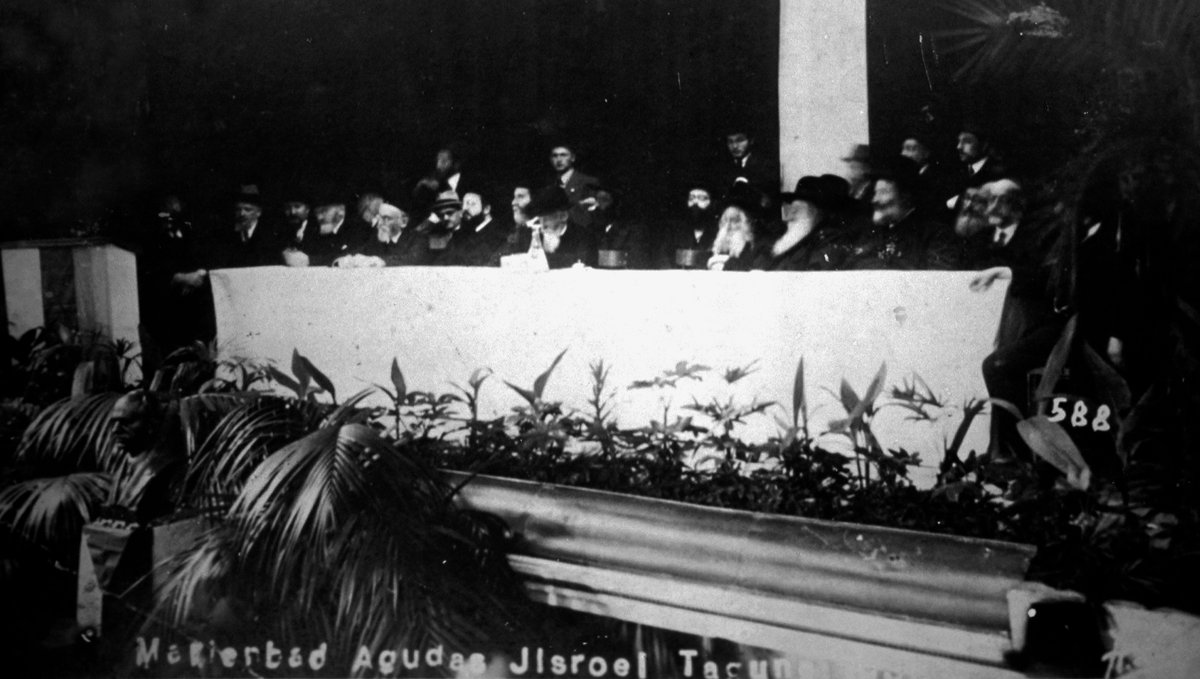
Marienbad. Elul 5697. The Third Knessiah Gedolah of Agudath Israel — the great assembly of the international Orthodox Jewish movement. Mariánské Lázně, Czechoslovakia. August 1937.
Marienbad — Mariánské Lázně in Czech — was a spa town in the Sudeten region of Czechoslovakia. Jews had been permitted to reside there from 1820, and from the late nineteenth century the town drew Hasidic courts from Galicia and Bukovina, with kosher hotels and ritual baths built to serve their summer visits. From August 18 to 23 of that year, the town hosted the Third Knessiah Gedolah of Agudath Israel. Knessiah Gedolah means the great assembly. Agudath Israel — founded at a conference in Kattowitz in 1912 — was the international Orthodox Jewish political movement, organized to represent observant Jews in parliaments and on questions of communal life. The Jewish Telegraphic Agency reported 720 delegates and more than 2,000 spectators present. It was the last such assembly held in Europe before the Second World War.
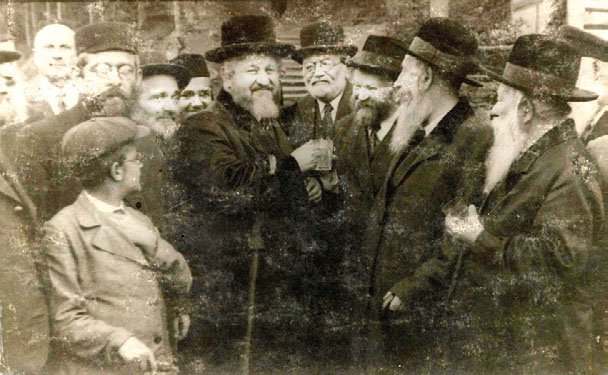
It was the last such assembly held in Europe before the Second World War.
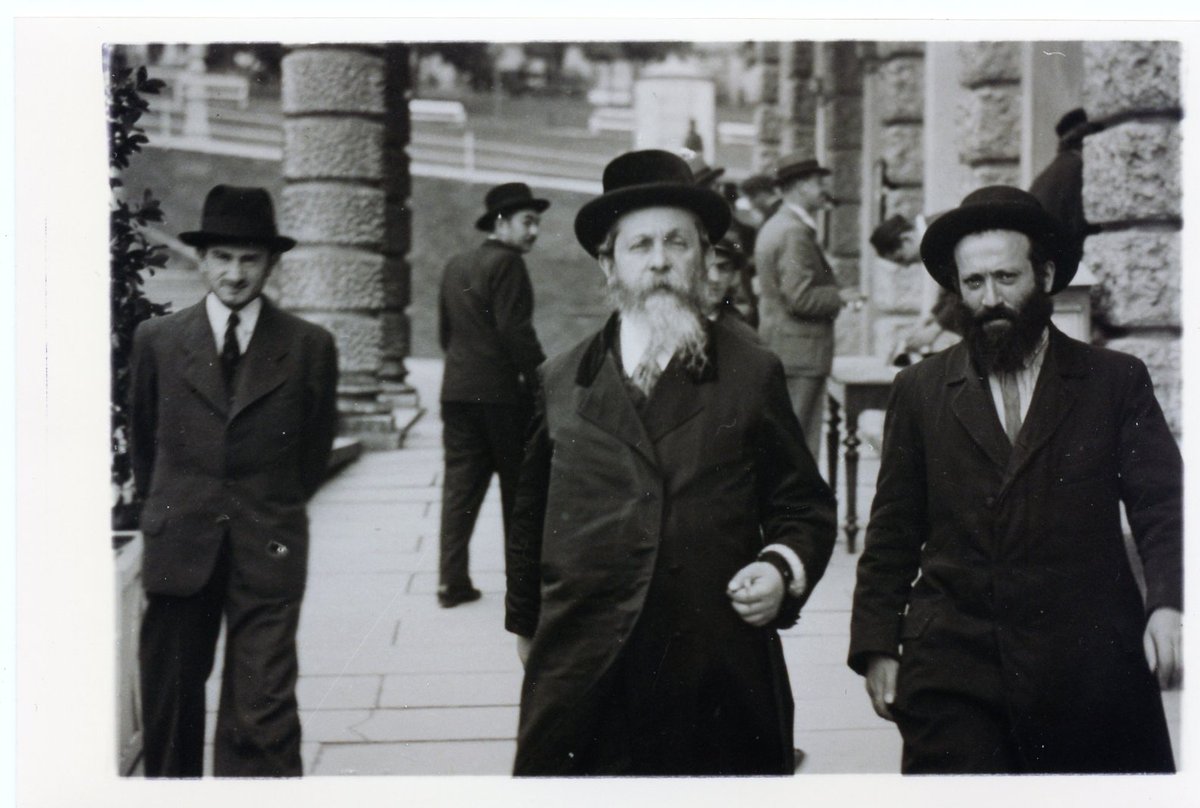
Marienbad, between 1929 and 1939. Rabbi Avraham Yehoshua Heshel of Kopyczynce with his gabbai. The gabbai is the rebbe's personal attendant, who manages requests from petitioners and the daily affairs of the court. Rabbi Heshel had succeeded his father as Kopyczynitzer Rebbe in 1934, leading the court from Vienna. He would reach New York in 1939, after the Anschluss closed the European chapter of his community.
He would reach New York in 1939, after the Anschluss closed the European chapter of his community.
Marienbad, between 1929 and 1940. Rabbi Avraham Yaakov Friedman of Boyan-Lemberg, with rabbis and Hasidim. Also pictured: Rabbi Avraham Yaakov Horowitz of Provinca and the Malicer Rebbe. The Boyaner dynasty had originated in Boyany, in Bukovina under the late Habsburg empire, and resettled in Lemberg — today Lviv — after the First World War. Marienbad served the court each summer for the Kur, the water cure for which the spa was known.
Marienbad, between 1929 and 1937. Rabbi Avraham Yaakov Friedman of Sadigura-Tel Aviv, the Abir Yaakov, with his nephew Rabbi Mordechai Shalom Yosef Friedman of Sadigura, the Knesses Mordechai. Between them, Rabbi Shaul Yedidya Elazar Taub of Modzhitz. Beside this photograph, Rabbi Avraham Yaakov Friedman of Sadigura, the Ikvei Abirim, as a child, walking with his father in Mariánské Lázně, between 1934 and 1939. The Sadigura court, founded in nineteenth-century Bukovina, had relocated to Vienna during the First World War. The Abir Yaakov was already living in Tel Aviv by 1937 — among the few Hasidic rebbes of his generation to settle in the Yishuv before the war. The child pictured here would later lead the Sadigura court himself.
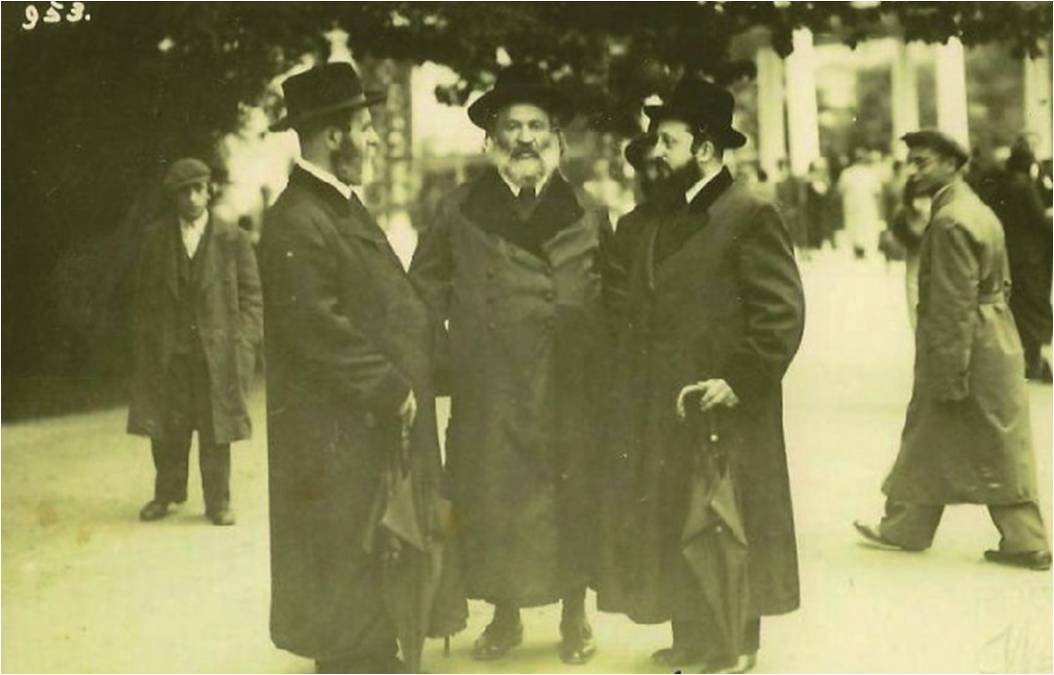
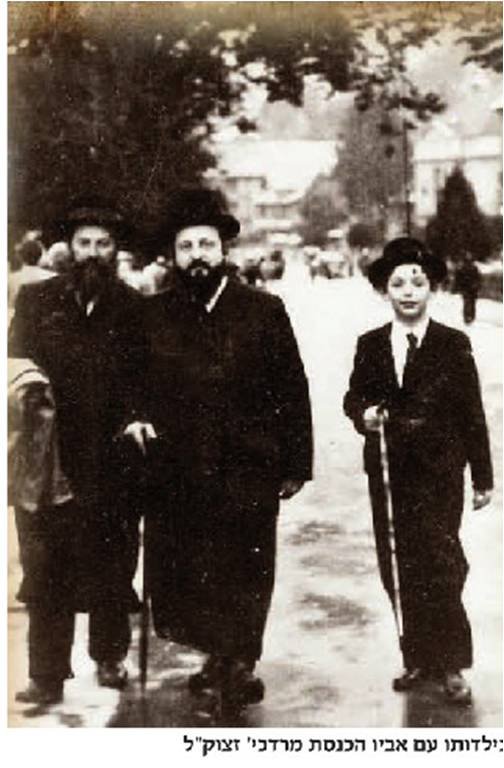
Rabbi Avraham Yaakov Friedman of Sadigora-Tel Aviv, Rabbi Mordechai Shalom Yosef Friedman of Sadigora, and Rabbi Shaul Yedidya Elazar Taub from Modzitz in Marienbad — תר"צ-תרצ"ז / Rabbi Avraham Yaakov Friedman of Sadigura " the Ikvei Abirim" in His Childhood — תרצ״ה-תרצ״ט
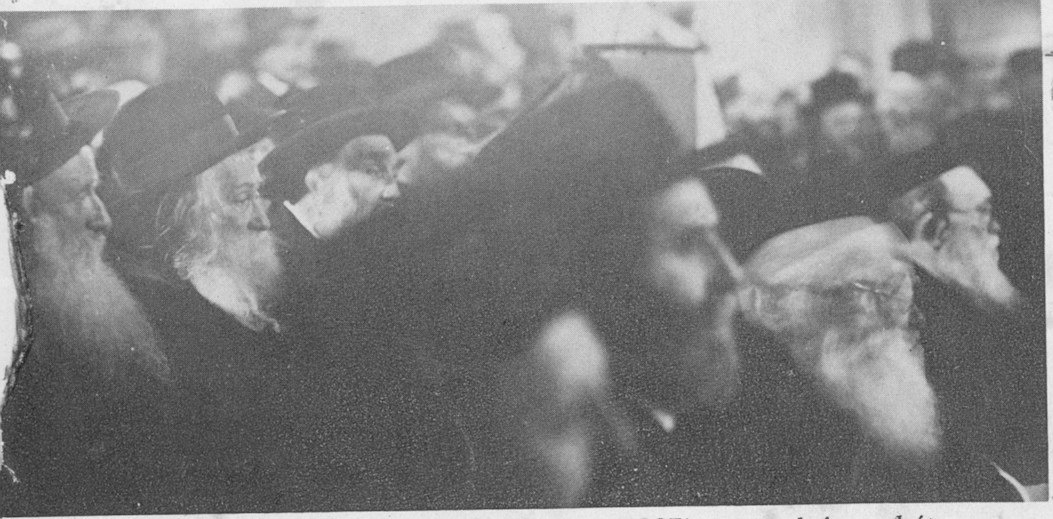
Marienbad, 1936. The preparatory assembly for the Knessiah Gedolah, held one year before the main convocation. From right to left: Rabbi Shaul Yedidya Taub of Modzhitz, the Imrei Shaul; Rabbi David of Skoczów, the Chesed David; Rabbi Avraham Mordechai Alter of Ger, the Imrei Emes; Rabbi Yitzhak Meir Levin; Rabbi Yaakov Rosenheim; Rabbi Avraham Yaakov Friedman of Sadigura, the Abir Yaakov; Rabbi Mordechai Shalom Yosef Friedman of Sadigura, the Knesses Mordechai. Yaakov Rosenheim of Frankfurt had served as president of World Agudath Israel since 1929. Yitzhak Meir Levin, son-in-law of the Imrei Emes, headed the Polish branch from 1930.
Three days in August. Elul 5697 — August 18 to 23, 1937.
Marienbad, August 1937. The table of honor at the Third Knessiah Gedolah. Among those pictured: Rabbi Avraham Mordechai Alter of Ger, the Imrei Emes; Rabbi Yitzchak Menachem Danziger of Aleksander, the Akeidas Yitzchak; Rabbi David Borenstein, the Chasdei David; Rabbi Mordechai Shalom Yosef Friedman of Sadigura, the Knesses Mordechai; Rabbi Avraham Yaakov Friedman of Sadigura-Tel Aviv, the Abir Yaakov; Rabbi Yehuda Leib Tsirelson; Rabbi Aharon Levin of Rzeszów. Rabbi Tsirelson, the Chief Rabbi of Bessarabia, was elected congress president. The American delegation was led by Rabbi Eliezer Silver of Cincinnati. Rabbi Chaim Ozer Grodzinski of Vilna — the senior halakhic authority of Lithuanian Jewry — was unable to attend on account of his health.
Rabbi Chaim Ozer Grodzinski of Vilna — the senior halakhic authority of Lithuanian Jewry — was unable to attend on account of his health.
Two views of the table of honor at the Third Knessiah Gedolah, photographed on different days during the assembly. Front row, among others: Rabbi Mordechai Shalom Yosef Friedman of Sadigura; Rabbi Avraham Yaakov Friedman, the Abir Yaakov; Rabbi Yehuda Leib Tsirelson; Rabbi Yonatan Benjamin Horowitz; Rabbi Yosef Tzvi Dushinsky; Rabbi Yaakov Rosenheim. Behind them: Rabbi Avraham Mordechai Alter of Ger; Rabbi Yitzchak Menachem Danziger of Aleksander; Rabbi Nachum Mordechai Friedman of Tshortkov, the Doresh Tov. Dushinsky had served since 1932 as head of the Edah HaChareidis, the separatist Orthodox community of Jerusalem.
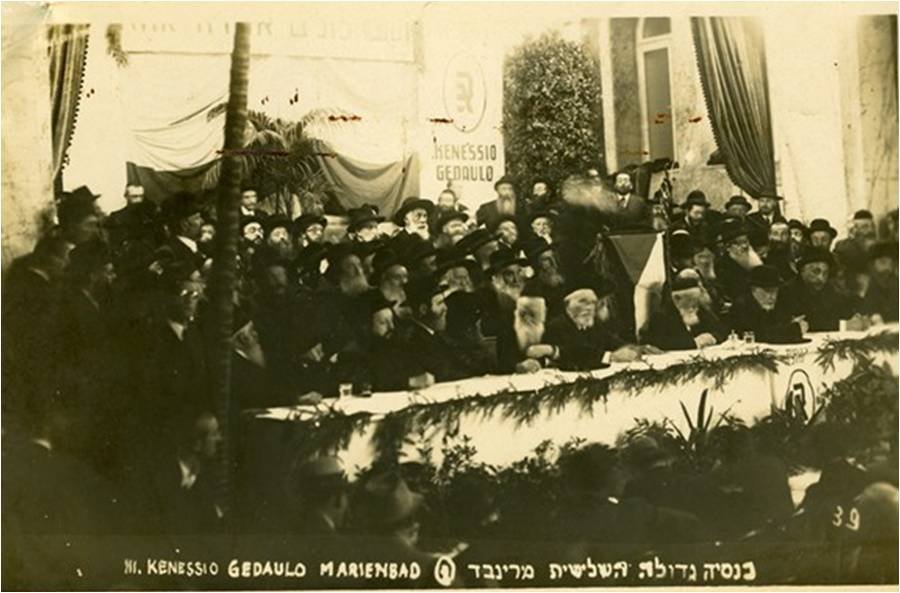
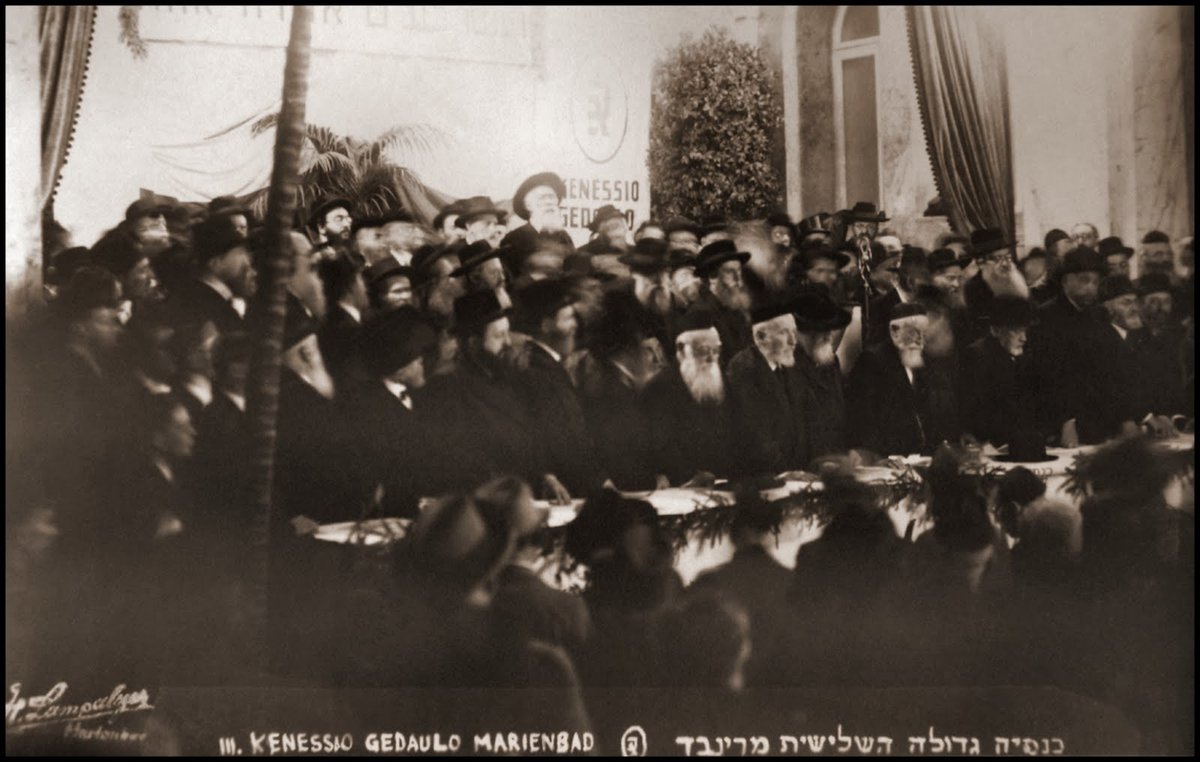
Table of Honor at the Third Great Assembly in Marienbad — אלול תרצז / Table of Honor during the Third Great Assembly in Marienbad — אלול תרצ״ז
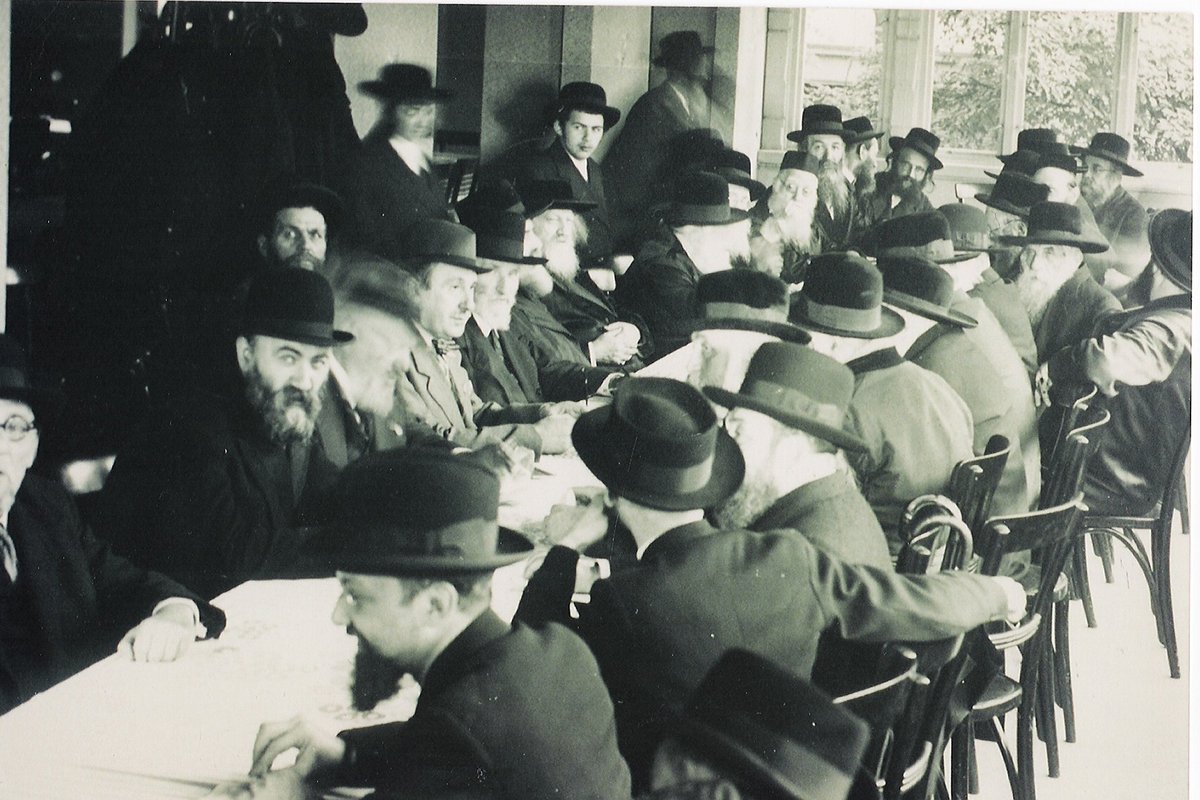
Marienbad, August 1937. The Moetzes Gedolei HaTorah — the Council of Torah Sages — convened during the Knessiah Gedolah. The Moetzes Gedolei HaTorah was the rabbinical council of Agudath Israel, established alongside the movement in 1912. Its members were grand rabbis of Hasidic dynasties and heads of leading yeshivas; its decisions were binding on the movement. Six weeks before the assembly opened, on July 7, 1937, the British Peel Commission had recommended partitioning Mandate Palestine into a Jewish state, an Arab state, and a neutral zone around Jerusalem. The Council debated whether Orthodox Jewry should support such a state. The resolution it adopted held that a Jewish state not based on the Torah would be a denial of Jewish origin. From right to left: Rabbi Yaakov Chanoch Sankevitch; Rabbi Zalman Sorotzkin; Rabbi Yehuda Leib Tsirelson; Rabbi Avraham Yaakov Friedman, the Abir Yaakov; Rabbi Yosef Tzvi Dushinsky, with his young son Rabbi Yisrael Moshe Dushinsky behind him; Rabbi Yonatan Benjamin Horowitz; Rabbi Mordechai Dubin. Facing them, looking toward the camera: Rabbi Ben Zion Wiesel of Torda.
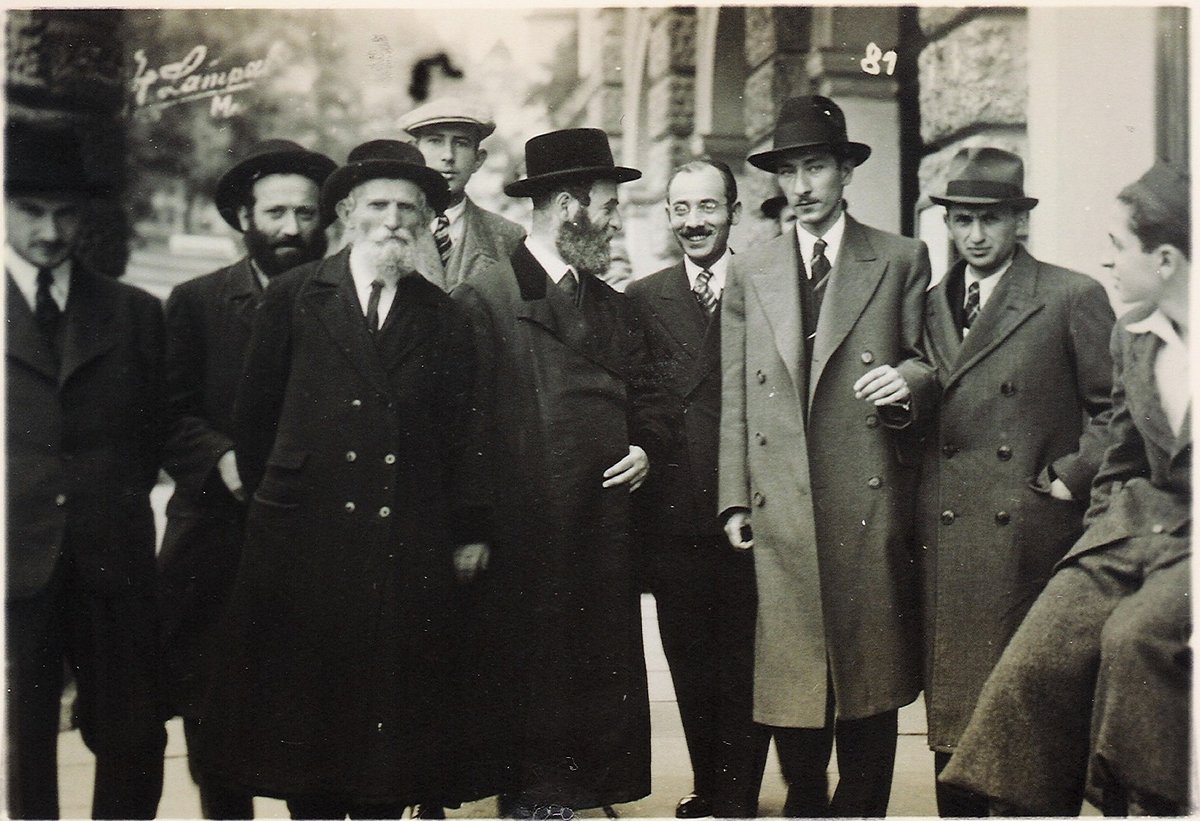
Marienbad, Elul 5697 — August 1937. Rabbi Avraham Yaakov Friedman of Sadigura-Tel Aviv, the Abir Yaakov, during the Third Knessiah Gedolah. He is surrounded by Hasidim and assembly delegates. On his left, his gabbai, Rabbi Aharon Abromovich. The Abir Yaakov had brought his court from Vienna to Tel Aviv before the war — among the few rebbes of his generation to do so. He came to Marienbad from the Yishuv to attend the assembly, and returned to Tel Aviv afterward.